

Table of Contents
I love old houses. I really do.
There’s just something about the creaks in the floor, the solid wood doors, and the little bits of history you find in the walls. My passion for renovating with granite started when I bought my first “project,” a 1920s bungalow. It had all the charm… and a 1970s kitchen. We’re talking avocado-green laminate and a vinyl floor that had seen better days.
Does this sound familiar? You love your home’s soul, but you hate its dated, failing finishes.
If you’re nodding along, we need to talk. You don’t have to pick between preserving charm and having a functional, beautiful home. The solution might just be one of the oldest, most durable materials on earth: granite.
Now, I know what you might be thinking. “Granite? Isn’t that for ’90s McMansions?”
Nope! We’ve come a long way from that one specific “Uba Tuba” green. Today’s granite options are vast, varied, and can look anything from rustic and earthy to sleek and modern. It’s a “forever” material that can actually enhance the historic feel of your home while giving you a surface that will outlive us all.
This isn’t just a gallery of pretty pictures. This is my ultimate guide to renovating with granite in an older home—the smart way. We’ll cover the good, the creative, and the “uh-ohs” to watch out for.
Why Renovating with Granite is Your Secret Weapon for Older Homes
When you’re dealing with a house that has its own personality (and maybe a few ghosts), you can’t just slap any new material in there. You need something that respects the past. Here’s why granite is my top pick.
Beyond the Beauty: The ‘Forever’ Material
Let’s be real: old houses need durable stuff. They’ve already proven they can last, and any new addition should have the same ambition.
Laminate? It peels and chips. Butcher block? It stains and scratches (and I’ve got the wine-stained counters to prove it). Tile? Hello, scrubbing grout lines for the rest of your life.
Granite is a beast in the best way possible. It’s an igneous rock, meaning it was literally forged in fire (molten magma, to be precise). It’s incredibly hard, ridiculously heat-resistant (go ahead, put that hot pan down), and scoffs at scratches. In a house that’s already 100 years old, this is a 100-year solution.
A Style for Every Century
The best part? Granite isn’t a single “look.” It’s a category.
- Want something that feels like an old-world bakery? A honed (matte) or leathered (textured) Absolute Black granite is stunning.
- Restoring a grand Victorian? A dramatic, large-patterned slab in a deep burgundy or blue can act like a piece of art.
- Just want a clean, timeless update for your Craftsman bungalow? A soft gray or white granite like ‘River White’ or ‘Bianco Antico’ blends right in.
The material itself is timeless, so it never feels like a “trend” you’ll regret in 10 years.
Protecting Your Investment (and Sanity)
Renovations are stressful. And expensive. I get it.
Granite is a fantastic investment. It’s one of the few upgrades that consistently adds dollar-for-dollar (and sometimes more) to your home’s resale value. But more importantly, it adds value to your life.
The maintenance is laughably simple. Once sealed (a 15-minute job you might do once every year or two), it just needs a wipe-down with soap and water. No special cleaners, no babying, no panicking when a guest spills red wine. For those of us living in and using our old homes, that low-maintenance sanity is priceless.
The Heart of the Home: Renovating with Granite in Your Kitchen
This is the big one. The kitchen is where granite gets to shine, and in an old house, it can be truly transformative.
The Big Decision: Countertops That Wow
This is the most obvious use, and for good reason. New countertops are the #1 way to change your kitchen’s entire vibe.
My advice for older homes? Think about contrast and harmony.
- Have original, dark wood cabinets? Don’t rip them out! A light-colored granite with some warm veining (think creams, golds, or light grays) can be absolutely stunning. It brightens the space without looking jarringly new.
- Working with simple, painted cabinets? You can go bolder. This is your chance to use a statement slab with lots of movement and color, like a ‘Van Gogh’ or ‘Magma Gold’.
Don’t Forget the Backsplash!
I’m a huge fan of continuing the same granite from the counter up onto the wall as a solid slab backsplash.
Why? Two words: No grout.
In an old home, a solid “full-height” backsplash feels both classic (like something you’d find in a high-end pre-war apartment) and incredibly modern. It’s one clean, seamless look, and wiping it down is a dream. If a full slab is outside the budget, using tiles of the same granite is a great alternative.
The Underrated Star: The Granite Sink
Seriously, don’t overlook this. A composite granite sink, or even one carved from a solid block, is a game-changer. They are tough, quiet (no “clang” when you drop a fork), and come in colors that can match your countertop perfectly.
An undermount sink (where the sink is installed under the countertop) is my personal favorite. It lets you wipe crumbs straight from the counter into the sink. It’s a small detail that makes you feel like a genius every single day.
Island Life: Creating a Focal Point
If you have the space, a kitchen island is amazing. In an older home, it can be the perfect bridge between the historic “work” areas and modern, open-plan living.
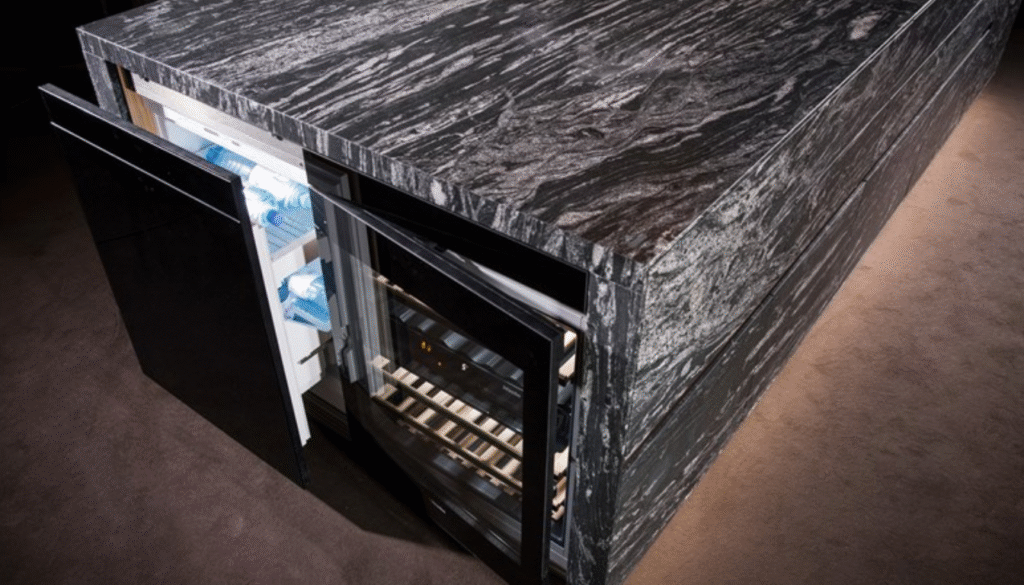
I love using a different, more dramatic granite for the island than for the “perimeter” counters. It makes the island feel like a special piece of furniture. This is where you splurge on that exotic, “wow” slab you fell in love with. It becomes the centerpiece of the room.
If you’re starting to get ideas, you might want to look at different types. For instance, we’ve seen some amazing projects using Black Granite Slabs that act as a perfect, dramatic anchor in a bright, classic kitchen.
From Drab to Spa: Bathroom Renovations with Granite
Old house bathrooms can be… challenging. They’re often small, oddly shaped, and tiled in questionable colors. Granite to the rescue.
The Vanity Top: Your Morning Masterpiece
This is the easiest, most high-impact upgrade. Even a tiny powder room can feel luxurious with a granite vanity top.
Because the space is small, you can often use a “remnant” (an off-cut from a larger project) and get a high-end look for less.
Pro Tip: Pay attention to the edge! A simple, squared-off “eased” edge looks clean and modern. For a more traditional or formal house (like a Victorian), a decorative “Ogee” or “Bullnose” edge might be the perfect finishing touch.
Creating a Walk-In Wow: Granite Shower Walls
Tired of your 1950s pink-tiled shower? Imagine replacing it with floor-to-ceiling slabs of granite.
This is the ultimate bathroom luxury.
- It’s 100% waterproof.
- There is NO GROUT to scrub. Ever.
- It looks like a five-star hotel.
You can use large-format granite tiles, but solid slabs (called “wall cladding”) are the real dream. It creates a stunning, monolithic look and will last, quite literally, forever.
Tying it Together: Floors and Thresholds
Don’t forget the details!
- Floors: Granite tiles are fantastic for bathroom floors. They are less slippery than some ceramics, and you can even get them with a “flamed” (rough) texture for extra grip. Plus, you can install radiant heating underneath them for warm feet on cold mornings.
- Thresholds: This is the piece that sits in the doorway or at the edge of the shower. A solid piece of granite (called a “saddle”) is so much better than the standard wood or metal. It’s waterproof, durable, and connects the design.
How to Choose the Right Granite for Your Home’s History
Okay, so you’re on board. But how do you pick one? Staring at a wall of slabs can be overwhelming. When renovating with granite in an old house, the key is “sympathetic design.”
Matching Eras: What Granite Goes With What Style?
This isn’t a hard-and-fast rule, but it’s a good starting point:
- Victorian (1840-1900): These homes are all about drama and detail. Don’t be afraid of rich colors (deep reds, blacks, emerald greens) and complex patterns.
- Craftsman (1900-1930): Think earthy, natural, and honest. My picks are honed or leathered granites in warm tones: browns, muted greens, and blacks. Anything that looks like it came from the earth (which, of course, it did).
- Mid-Century Modern (1940-1970): These homes look amazing with cleaner, more uniform granites. A solid “Absolute Black” or a subtle “Steel Grey” in a polished finish is perfection.
Color Theory 101: Working with Original Woodwork
Most old homes have beautiful, original woodwork (trim, cabinets, floors). This is your starting point.
- Rule 1: Don’t try to “match” the wood. You’ll never get it right, and it will look strange.
- Rule 2: Go for contrast or harmony.
- Contrast: Dark (cherry, mahogany) wood + light granite (cream, white, light gray). This is a classic, no-fail combo.
- Harmony: Light (oak, pine) wood + warm granite (golds, tans, browns). This creates a cozy, cohesive feel.
Finishes Matter: Polished vs. Honed vs. Leathered
This is so important! The finish of the stone changes its entire personality.
- Polished: This is the classic, shiny, mirror-like finish. It’s high-impact, reflects light (great for small, dark rooms), and really brings out the color and depth of the stone. It’s also the most stain-resistant.
- Honed: This is a matte (non-shiny) finish. It’s soft, smooth, and has a more subtle, velvety look. I love honed granite for older homes. It feels less “new” and blends beautifully with aged materials like brick and old wood.
- Leathered (or Brushed): This is my personal favorite. It’s a textured finish that has a soft sheen and a slight “bumpy” feel. It’s amazing at hiding fingerprints and water spots. It just feels old and substantial.
Beyond the Kitchen & Bath: 7 Creative Ways to Use Granite
This is where we have some fun. Granite is so much more than just a countertop.
1. The Welcoming Hearth: Fireplace Surrounds
This is a no-brainer. Granite is non-combustible and looks incredible as a fireplace surround and hearth. You can use a single, dramatic slab for a modern look or tiles for a more traditional feel. It’s an instant, elegant upgrade.
2. The Outdoor Oasis: Patios and Walkways
Granite isn’t just for indoors! Granite pavers and steps are basically indestructible. They won’t fade in the sun, crack in the winter, or get stained. A product like a Flamed G654 Granite is perfect for this—the flamed texture gives it great grip for outdoor use.
3. The Functional Detail: Windowsills
This is a genius old-house hack. Rip out that peeling, water-damaged wooden windowsill (especially in a kitchen or bathroom) and replace it with a solid piece of granite. It’s completely waterproof, will never rot or warp, and looks incredibly custom.
4. The Statement Entryway
Your foyer is the first impression. Using granite tiles—maybe even in a checkerboard or with a custom medallion—creates a durable, grand entrance that tells guests, “This house is solid.”
5. The Durable Utility Space
Who says the laundry room or mudroom has to be ugly? These are the hardest-working rooms in your house! A granite counter for folding laundry or as a “drop zone” by the back door is a smart move. It can handle wet boots, muddy paws, and laundry baskets without a single complaint.
6. Custom Furniture Tops
Got a beautiful antique dresser or sideboard that’s seen better days? Have a piece of granite custom-cut to fit the top. It protects the wood underneath and gives the piece a new, elegant life. This is also great for outdoor table tops.
7. The Finishing Touch: Outlet Covers
Yes, really! For the true enthusiast, you can have switch plates and outlet covers custom-made from the same granite as your backsplash. It’s a tiny, high-end detail that makes the stone look like it truly belongs.
The “Uh-Oh” Factor: Challenges of Renovating with Granite in an Old House
I’d be a bad friend if I only told you the good parts. Renovating with granite in an old home has a few special… quirks. Forewarned is forearmed!
“Is Your House… Sinking?” (Weight & Structural Support)
Let’s not sugar-coat it: granite is HEAVY. A typical slab weighs 12-20 pounds per square foot.
Your 1920s floor joists were not built with a 1,000-pound kitchen island in mind.
You MUST check your structural support. Before you fall in love with a giant slab, have a contractor or structural engineer peek into your basement or crawlspace. You may need to add some simple, inexpensive blocking to reinforce the joists. It’s a critical step—don’t skip it.
The Uneven Truth: Scribing to Crooked Walls
I have news for you: nothing in your old house is straight. The floors aren’t level, the walls aren’t plumb, and the corners aren’t square.
This is why professional installation is not optional.
You can’t just slap a rectangular slab of granite against a wavy 100-year-old plaster wall. There will be huge gaps. A skilled installer will use a technique called “scribing,” where they carefully trace the wall’s imperfections onto the stone and cut it for a perfect, tight fit. This is an art form, and it’s what separates a “meh” job from a masterpiece.
Preservation vs. Gut Job: Keeping the Charm
The temptation is to gut everything. But the soul of an old house is in its details. The goal of a good renovation isn’t to make it look brand new; it’s to make it look respectfully updated.
Before you demo, ask yourself:
- Can I keep the original cabinets and just add new counters?
- Can I blend the granite with the original wood trim instead of painting it?
- Can I use a granite color or finish (like honed) that feels appropriate to the home’s era?
A sympathetic renovation is always the best one.
Let’s Talk Logistics: Budget, Sourcing, and Installation
How Much Are We Talking? (The Money Question)
Granite is an investment. The price can vary wildly based on a few things:
- The Stone: “Common” granites (like G654 or Uba Tuba) are very affordable. “Exotic” granites (with wild colors and patterns) are much more expensive.
- The Format: Tiles are the cheapest. Pre-fabricated counters are mid-range. Full, custom-cut slabs are the most expensive.
- The Labor: Fabrication (cutting the sink holes, etc.) and installation are a significant part of the cost.
It’s not the cheapest option. But as I said, it’s a “buy it once, cry once” material.
Sourcing Your Perfect Slab
You have options!
- Local Stone Yard: You can go see, touch, and pick out your exact slab. This is great for “wow” pieces where the pattern is key.
- Supplier/Wholesaler: This is where you can often find better pricing and a wider variety, especially for large projects. For example, we at Zenova Stone work as a global supplier, which means we can source materials from quarries all over the world.
DIY vs. Pro: A Word of Warning
I’m a big DIYer. I’ll tile, I’ll paint, I’ll build.
But I will not install a granite slab.
Here’s my personal opinion: Don’t do it. It’s not just heavy; it’s brittle during transport. It’s shockingly easy to crack a $3,000 slab trying to carry it through a doorway. It requires highly specialized, expensive tools for cutting and polishing.
Pay the pros. This is one job you won’t regret outsourcing.
Maintaining the Magic: How to Care for Your Granite
This is the best part. It’s so easy.
Sealing: The 15-Minute Job That Saves You Headaches
Granite is porous (it has tiny holes), so it can stain if you leave a puddle of oil or wine on it for days. The fix? Sealer.
A good granite sealer is a 15-minute, wipe-on, wipe-off job. You might need to do it once a year, or (with modern sealers) once every 5-10 years.
The Water Drop Test: How do you know it’s time to seal? Drip a few drops of water on the counter. If it beads up, you’re good. If it soaks in and darkens the stone, it’s time to re-seal.
Daily Cleaning: Keep it Simple
Please, step away from the harsh chemical cleaners.
- Correct: A few drops of dish soap and warm water on a rag. That’s it.
- Wrong: Vinegar, lemon juice, Windex, or anything acidic or abrasive. These can etch the stone or strip the sealer.
If you want more technical details, the Natural Stone Institute is a fantastic, non-biased resource for care guides.
What About Stains? (A Quick Fix)
Don’t panic! If you get a stain (usually oil), you can easily pull it out with a “poultice”—a paste of baking soda and water. You spread it on, cover it with plastic wrap, and let it sit overnight. It works like magic.
My Final Thoughts: Is Renovating with Granite Right for You?
Look, renovating an old house is a labor of love. It’s a balance between respecting the craftsman who built it 100 years ago and making it work for your family today.
Renovating with granite is, in my opinion, the perfect way to do that.
It’s a material that’s as old as the Earth itself. It has a story, a weight, and a permanence that flimsy, modern materials just can’t match. It’s a commitment, yes. But it’s an investment in your home’s future that beautifully honors its past.
If you love your old home but hate its ’80s kitchen, or you’re just tired of scrubbing grout in a 1950s bathroom, this might be the perfect, one-and-done solution you’ve been looking for.
So, what’s your biggest renovation challenge in your older home? Have you considered granite? Let me know your thoughts or questions in the comments below!
And if you’re just starting your inspiration journey, feel free to browse our Products page to see just how many options are out there. Happy renovating!